East Africa: Kenya, Rwanda and Uganda

Last Update
/
5
Min
Departure
I'm finally on my way — all things come in their time! This was a trip made without much planning. Suddenly I had a month of vacation. I had thought about Iceland, Russia, or Italy, but after checking itineraries and visas, none of them quite worked out. Then I came across an ad for an Intrepid tour to Africa — easy visas, three East African countries all in one trip, and the timing was right. That settled it. I've always known that someday in this life I would go to Africa. That ancient, mysterious land has always called to me. I just never imagined it would happen quite suddenly and quite so simply. With time to spare, I decided to add three days in Dubai — also on my bucket list, but always too far to bother with. This time it was right on the way. I spent two days frantically searching for flights online, and finally locked in the itinerary: Washington via Paris to Dubai, then Dubai to Nairobi; and from Nairobi via Amsterdam back to Washington. Amsterdam is a city I've long dreamed of visiting, but without time to arrange a Schengen visa, I had to let it go.
On the flight to Paris, passing over New York, Manhattan blazed with lights in the deep of night. It's only on airplanes that I can truly idle — sit back and watch a film. I chose Our Times — a story of youth, of simple feelings, and I found myself moved to tears. Back then, the sky was so blue, the sun so bright, and everything was good. Dreams were high too, and what made it beautiful was that they still seemed possible. Live with hope, through a life that sometimes disappoint.
When the film ended I looked out the window. The plane threaded its way among the stars, and I felt I could reach out and grasp the handle of the Big Dipper.
France — Paris always carries the scent of powder. Even Air France's in-flight safety video is impossibly elegant. The airport advertisement made me smile.

Dubai
The plane landed at Dubai airport. In the distance, a few white robes drifted through the brilliantly lit terminal. This is a remarkable country. The airport was thick with large groups of Indians.
Dubai seems like a Las Vegas filled with exotic atmosphere — but more romantic, more extreme, more orthodox than Vegas. White and black robes drift past on the streets — romantic, graceful. Here, everything must be the world's best: the tallest building, the most luxurious hotels, luxury cars on every street. Walking around, you can smell money everywhere. The expatriate population is enormous; most service workers are Indian or Southeast Asian. It was the height of summer — over forty degrees Celsius, with high humidity. The moment you step out of an air-conditioned room, you can barely breathe. Hot. Hot. Hot. Nothing but hot.
I had two full days in Dubai and packed them completely. I bought a Big Bus city tour pass. When you're short on time in a new city and haven't done enough research, the Big Bus or City Sightseeing hop-on/hop-off tour is an excellent choice — a double-decker takes you around the main sights with commentary, and you can get on and off as you want.
On the first day, I spent the morning at Dubai Mall. It was extraordinary. The valet parking lot alone was a showroom of luxury cars — Ferraris end to end, with Land Rovers practically counting as budget vehicles. Dubai's official police cars are Lamborghinis. The mall itself was grand, with more artistic flair and entertainment than American malls. Silver human figures plunged down waterfalls from ten meters up. Exotic creatures drifted lazily through the aquarium. The shops were much like any American mall — from LV and Hermès to H&M and Gap. Even the American burger chain Five Guys had been elevated to something grand, packed inside with white robes and black robes.
Coming out of the mall, I visited Dubai's old city — the commercial districts on both sides of Dubai Creek, where you can glimpse what Dubai once was. An authentic gold souk, a spice market, crowded shops, narrow streets, and eager shopkeepers beckoning from doorways. In the evening, I went up Burj Khalifa, the world's tallest man-made structure. The elevator whisked me to the observation deck on the 124th floor in an instant. Looking down, buildings of thirty floors looked like toy figures. Looking out, an orange sun was slowly sinking into the hazy Persian Gulf.
On the second day, I took the Big Bus to the beach area. The Palm Jumeirah is a feat of human imagination — sand pumped up from the sea floor, sculpted into a palm-tree-shaped artificial island. At its tip stands the legendary Atlantis, a resort of extraordinary luxury.
Dubai always gave me a disorienting feeling — a sense of being somewhere I couldn't quite place. Here, deep Islamic religiosity and advanced material civilization coexist. Wandering through the shops of Dubai Mall, I could have sworn I was in America — then the call to prayer rang out, and I remembered: this is a conservative Muslim country. While vigorously imitating the West's material heights, Dubai remains deeply traditional in religion, culture, and politics. It strives to collect the world's superlatives — shopping malls, resorts, luxury hotels, fine cars — all at a European and American standard of excellence, and then pushed further, more extreme, because it has more money. And yet religiously and culturally it stands apart from the West. Men in flowing robes, like elegant scholars from ancient China; women in full black, faces covered, only a pair of eyes visible — some with even those veiled in black gauze, deeply mysterious. Politically, it remains autocratic and dynastic. And yet, for all of this, I am still awed by this country's ambition and vision. Less than a hundred years ago it was a backward Arabian tribal sheikhdom; today, using the immense wealth that oil brought, it has built the pinnacle of human material civilization on desert and gravel, created one world record after another, turned dreams into reality, made fairy tales come true.
Africa Begins
The day has finally come — my Africa journey officially begins. Last night, I had accidently set my alarm for weekdays only, so when the front desk called to tell me my taxi had arrived, I was still asleep. This time I set a personal record: from opening my eyes in bed to sitting in the taxi — seventeen minutes. In that time I dressed, washed my face, brushed my teeth, put in my contacts, stuffed things into my suitcase, and took the elevator down. I finished moisturizing, putting on my makeup, and packing — all in the taxi. It was a delightful discovery: with a little strategic thinking, you really can squeeze a surprising amount out of the day.
Everything went smoothly — taxi, airport, check-in, security. But the airport of Sharjah, the emirate next to Dubai, was a completely different world. People of every kind, dressed in every kind of way. Two older men with bare torsos, large white cloths draped over their shoulders, looking like they were about to lead a peasant uprising, their eyes filled with the anger of those at the bottom of society and a bewilderment at the wider world. Only half an hour's drive away, and yet a world apart from Dubai's sleek international crowd.
On the plane, before takeoff, the screen dropped down and displayed a prayer: "May Allah bless us with a safe journey. May He protect our property in our absence." I had no words.
The plane took off. I fell into a deep sleep. After some time I was woken by a woman behind me, quacking on and on in a voice like a duck, while the man to my left droned through his prayers.
At last — Nairobi. On the plane I had chatted with a Kenyan girl sitting next to me. She worked in Dubai and was warm and generous — she even offered to give me a ride, a stranger, to wherever I was going.
The half-hour drive from the airport to the hotel took well over an hour. Who would have thought Nairobi could be so congested on a Sunday afternoon? Every time the car stopped, vendors swarmed over with all manner of household goods — the variety was staggering. Full-length mirrors, furniture, bananas, vegetables, everything you could imagine — a rolling supermarket. Nairobi, notorious as it is, was filthy and chaotic beyond measure. Garbage and wastewater everywhere.
At last — the guesthouse. I met the guide and my fellow travelers. Tomorrow, we set off for the legendary Maasai Mara.
Maasai Mara
We set out at the crack of dawn. A Mercedes sedan converted into a massive overland vehicle: passengers on top, kitchen equipment, tables, chairs, and tents below, luggage in lockers at the back. This was the vehicle that would carry our group of eleven travelers and three crew members across East Africa for sixteen days.
The road from Nairobi to Maasai Mara was terrible — rutted dirt tracks, with the occasional serious crater. Dust thrown up by the vehicle sent everyone coughing. After six or seven hours of what they call "African Massage," we finally reached our camp site. We ate a simple lunch and then eagerly headed to the Maasai Mara National Reserve for our first encounter.
Maasai Mara — the world-famous wildlife reserve. We entered the reserve in the late afternoon. A vast, limitless plain — quiet and still, without sound. In the setting sun, giraffes, zebras, and buffalo grazed peacefully or wandered in graceful unhurried motion. Shadows of trees and clouds dappled the great plain. "Mara" means "spotted." My heart went still. This is the animals' world. They are used to game vehicles and pay us no attention. A pair of lions napped in the roadside grass. Several vehicles, dozens of people, pulled up and began clicking cameras. The lions lazily stretched, then put their heads back down and went on sleeping. August is migration season in Maasai Mara — huge herds of zebra and wildebeest roamed the savannah in search of food. As the light faded, we said a quick hello to our hosts here, watched the sunset, and returned to camp.
The first night camping — I was delighted to discover there was hot water for a shower. The tents Intrepid had provided were solid, waterproof, with thick mattresses — very comfortable. In the fresh open air of the wild, I sank into deep sleep.
Hot Air Balloon Ride
Five o'clock: the alarm woke me. I rushed through brushing my teeth and splashing water on my face — still late. The guide and the jeep taking us to the balloon were already waiting. "You are late." Under a sky full of stars on the way there, I glanced up without thinking and a shooting star streaked across — I quietly made a wish. Half-asleep, jolting through the darkness for over an hour, we finally reached the launch site. The pilot gave a briefing. The takeoff method was unlike anything I'd experienced before: the basket was laid on its side on the ground, and you had to lie down horizontally inside it; as the balloon filled with hot air, it would pull the basket upright. Completely different from the time I'd flown in Cappadocia. In the darkness, with a whoosh, a flame of blue fire ignited and the huge balloon slowly climbed.
Watching the Great Migration from mid-air was spectacular. Vast herds of zebra and wildebeest massed along the Mara River, waiting for their leader's signal before plunging across in a surging, stumbling torrent. Below on the sweeping plains, animals ran free — life in its most liberated state. Today we watched a perfect sunrise.
After the balloon landed gently, breakfast was waiting for us. This is a Maasai Mara tradition: on the limitless savannah, a long table is laid out with fried eggs, sausage, bacon, and champagne. We celebrated together — Maasai Mara, Africa, adventure.
In the afternoon, another game drive. The African savannah offers not only freedom but brutal competition for survival. We saw not only graceful giraffes, beautiful zebras, and drowsy lions, but also the bones of prey: a zebra, half-eaten, surrounded by a circle of birds and hawks.
A Day on the Road
Last night was rather cold. In the morning we packed up, ate breakfast and took down the tents. The people in our group are very kind — seeing that we hadn't finished packing, several came over without a word and helped. My tentmate was a sixty-five-year-old Australian woman, Lotus. She nearly drove both me and the guide to madness. We were already running late, and she calmly, methodically, folded every single item with meticulous precision before placing it in her pack — and if it wasn't quite right, she'd take it out and start again. Sometimes speed matters more than perfection.
Today was a full day of driving. In the afternoon I felt a battle breaking out inside my body — a low fever. I later learned that Lotus had caught a cold the night before. By rights, anyone who falls ill should move to their own tent. I carried a quiet resentment toward her for this.
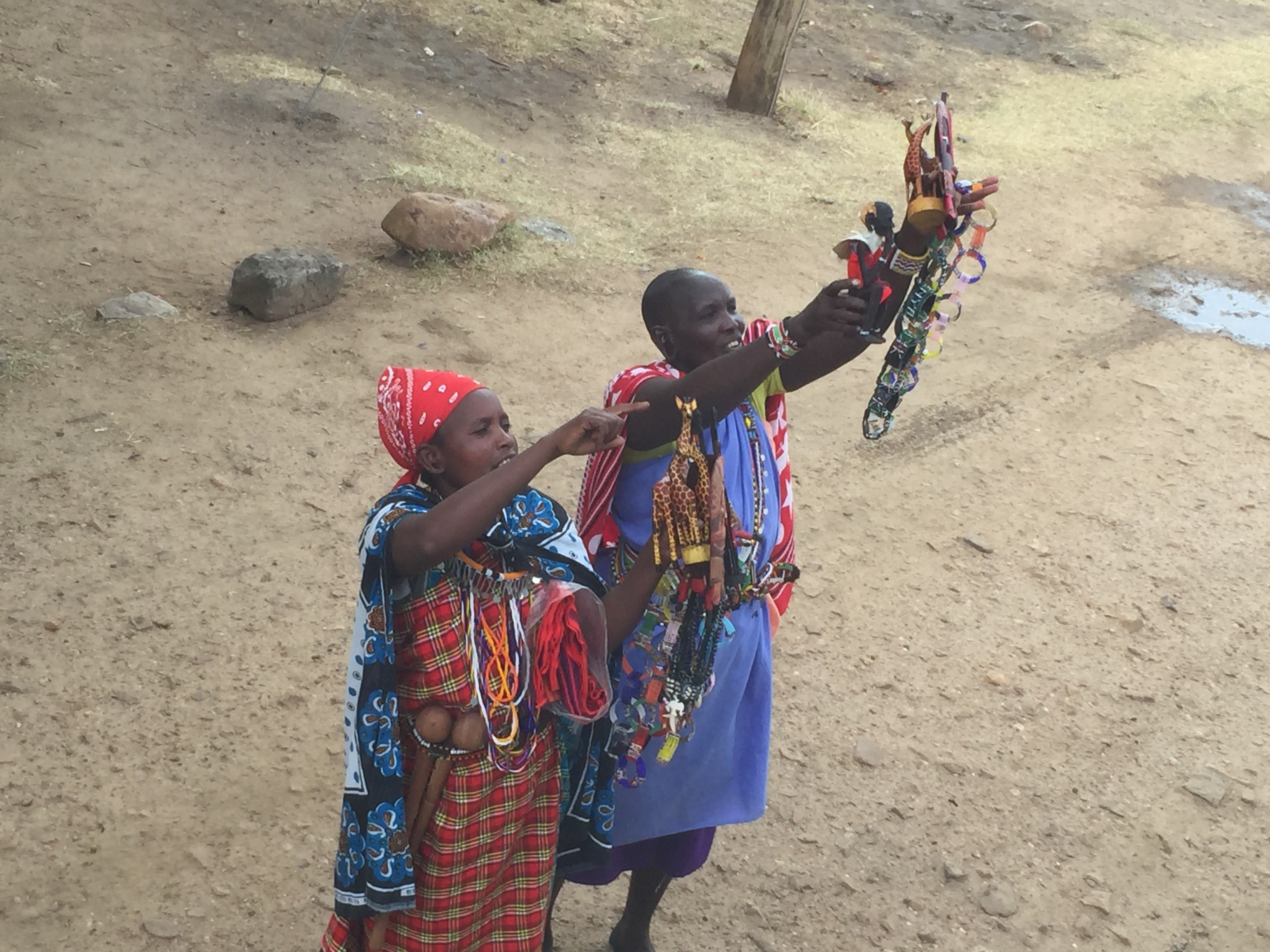
At last the car left Maasai Mara and hit tarmac — the entire vehicle erupted in applause and cheers. My organs had been thoroughly rearranged. The car headed west into the Kenyan highlands, and the scenery transformed. Neat rows of tea plants painted the hillsides green. On the rolling hills, houses with red roofs and white-washed walls appeared. Roadside stalls of rough wooden planks were laden with potatoes, apples, and chickens with their legs bound together. Every time our car passed, children would run to the roadside and wave — and when we waved back, their faces opened like flowers.
Kenya → Uganda
Last night I took a cold medicine and slept soundly. I can now wake easily at around five. Traveling with a group of strangers in a bus through a strange land — travel lets me reboot. Forget the tangled past; start everything fresh. I feel my body fill with new energy.
Today we crossed the border from Kenya into Uganda. Sitting in the bus waiting for immigration checks, I watched a fashion show through the window. Ugandan women dress in vivid, well-coordinated colors. Uganda is full of Huawei and bananas — Huawei shops every few meters, and bananas everywhere, ripe and fragrant and sweet.
By afternoon, the cold medicine from the day before had worn off, and I was running a high fever. I dozed in the bus for four or five hours.
On the Road in Uganda
This morning — much better. I remembered the prayer displayed on that Arabic airline's screen before takeoff: something to the effect of, may Allah bless our journey, and protect all that we leave behind. So I thought, when in Rome — and said a little prayer myself: Allah, keep me healthy and safe. Today it worked.
Uganda is beautiful — hills, lakes, and an economy visibly more developed than Kenya's. The tarmac roads are smooth and wide, most buildings are brick, and there is even green space in the cities. By comparison, Kenya's buildings were mostly mud brick and wooden boards, with rubbish everywhere. Last night's Red Chilli guesthouse was lovely too.
After a day of driving, we arrived at the famous Queen Elizabeth National Park toward evening. It is noticeably more humid than Maasai Mara — lush and verdant inside the park, a green savannah dotted with lakes. Herds of elephants rested and grazed beneath the trees; buffalo wallowed in muddy pools. Everything felt quiet and at peace.
Queen Elizabeth National Park
Today was one of the highlights of the entire trip. We set out in the morning to another beautiful African orange sunrise. In a chimpanzee sanctuary, we found a group of chimps — mothers and babies. We also spotted a troop of red-tailed monkeys, swinging and leaping freely through the treetops. On the way back, the car stopped and seven or eight local women came aboard, dressed in brilliantly colorful clothes, shouldering and balancing on their heads baskets overflowing with ripe yellow bananas.
The afternoon boat ride was the best. Our boat traveled the 32-kilometer Kazinga Channel connecting Lake George and Lake Edward. Hippos soaked and sunbathed in the water; buffalo lounged lazily on the banks; crocodiles surfaced mysteriously, half a head visible; all kinds of birds perched on buffalo backs searching for food or rested in waterside grasses and treetops. This is reportedly home to the world's largest population of hippos. What had seemed like a quiet, lazy afternoon suddenly erupted — two hippos began fighting in the middle of the river. One launched itself from the water, jaws wide, lunging at the other. In and out of the water, back and forth, several rounds — with no commentary and no clear winner.
Mweya Safari Lodge is extraordinary — perched on a hilltop overlooking the lake.
Arms aching from holding the camera, fingers sore from clicking the shutter, we drove back to camp as the sun went down. Banana trees as far as the eye could see. The cacti here are so dense and bushy they seem to be trying with all their might to become proper trees.
That evening, a red moon rose over this ancient African land. I thought of The Lion King. After dinner, Mambo took us to find hippos. I followed Mambo through the darkness, heart in my mouth, when — suddenly — several hippo calls from close behind me, rapid footsteps — I nearly leaped out of my skin and grabbed Mambo's arm with both hands. A false alarm: it was Wilson the cook impersonating hippos. I couldn't decide whether to laugh or be furious. We kept looking. Between the dark tree shadows — two points of light. Mambo shone his torch: three enormous hippos grazing. Mambo crouched, walked over, placed the torch on the ground, then stepped away. The hippos saw the light and turned toward it, lumbering in its direction.
Lake Bunyonyi
Another beautiful sunrise this morning. Every day: sunrise, sunset, a red moon, a sky full of stars. I have returned to the dreams of my childhood. In those dreams, I am a small lion cub running free across the African plains.
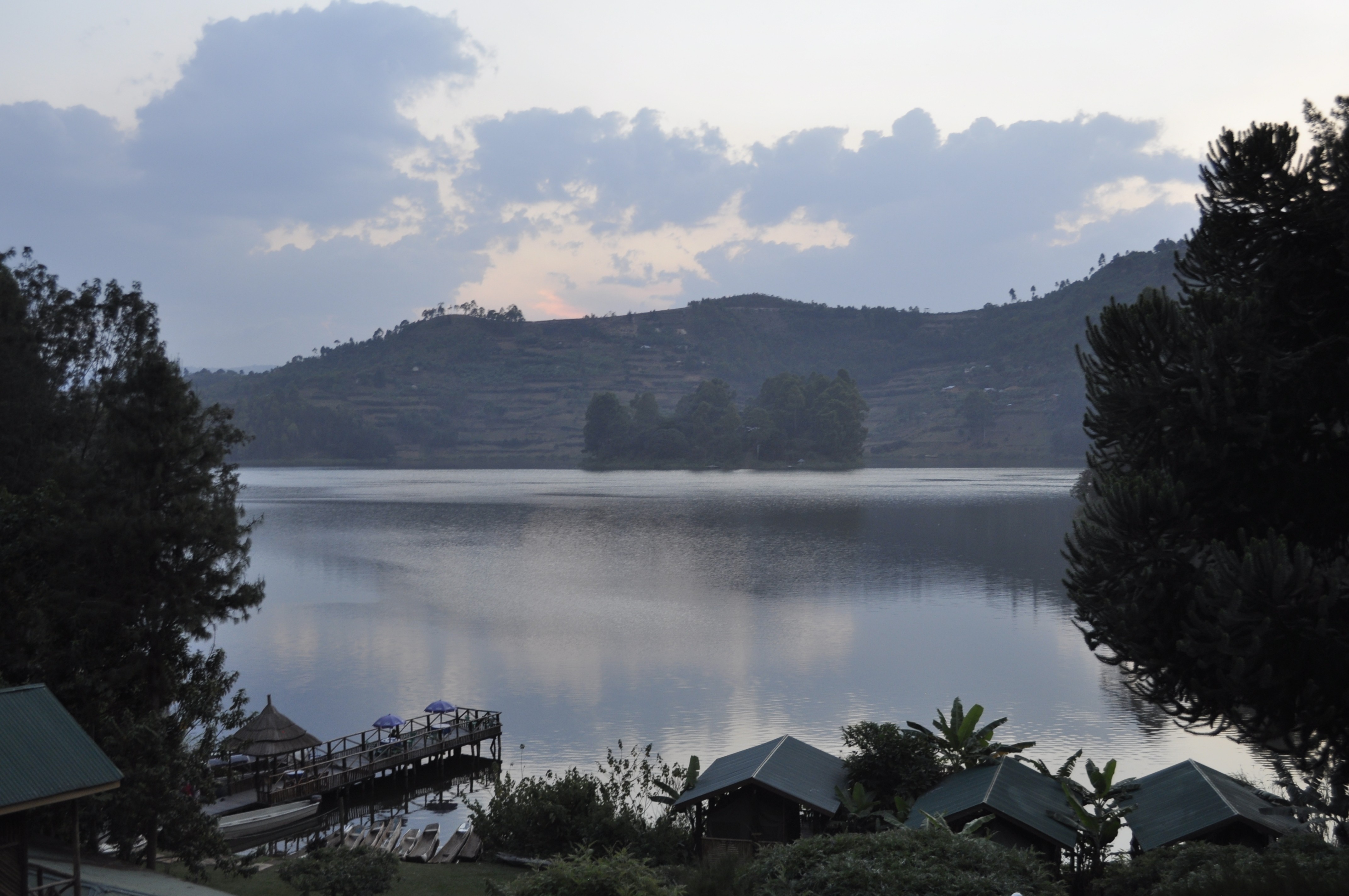
After most of a day's travel, we arrived in the afternoon at the exquisite Lake Bunyonyi, surrounded by mountains. Bunyonyi has a beautiful legend. A girl and a boy were together; the girl became pregnant. The villagers placed her on an island in the middle of the lake. Every Thursday, the waters rise and flood the island. If the boy loved her, he could rescue her before the water covered the island, and they would leave the village together to start a new life elsewhere. If he did not, she would drown.
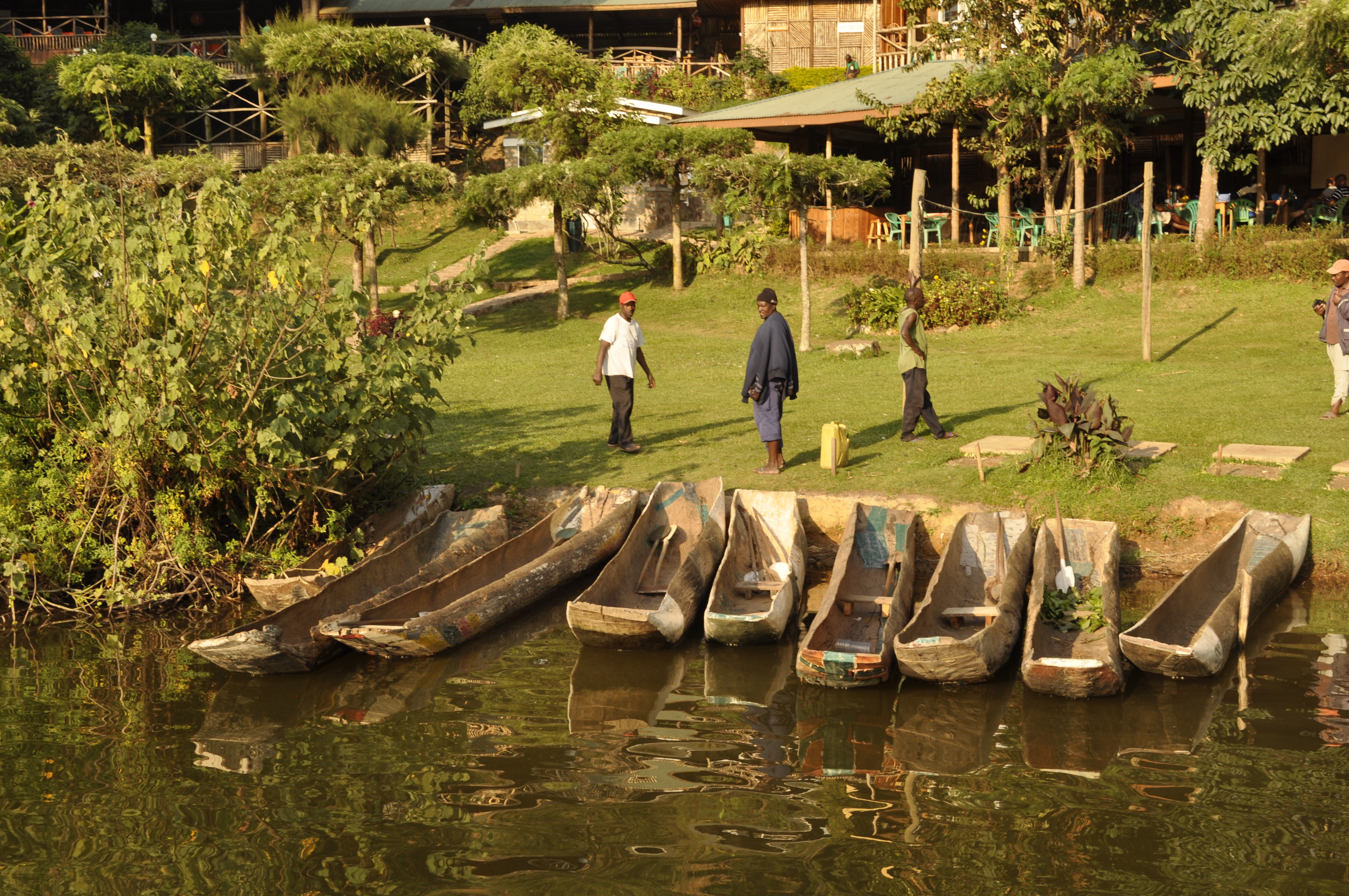
We settled into the Overland Resort on the hillside. I shared a treehouse with Makayla from Austria. Not exactly a treehouse — more a platform built beneath a great tree halfway up the slope, with a tent on the platform, mountains at the back and the lake spread before us, a breathtaking view. In the afternoon I went out in an African dugout canoe with Jo from Poland. Jo is a talker — words without end — and our little boat spun in circles on the water for two hours, getting nowhere. I finally understood the meaning of "odd couple." In the evening, Mambo's fried fish was extraordinary. Full and content, we went back to the tent and slept.
Uganda → Rwanda
Last night, music from somewhere played from midnight until dawn. In the morning, almost everyone on the bus looked exhausted.
We set out in the dark. Thin white mist still drifted through the mountains. Early in the morning, we crossed the border into Rwanda. In the capital Kigali, we visited the Genocide Memorial. One hundred days. Eight hundred thousand were killed — 20% of Rwanda's population, 70% of the Tutsi population. The city before me, with its high-rises and green tree-lined streets — what nightmare had it lived through just over twenty years ago? A wreath at the memorial read: "Never again."
In the afternoon I browsed the main market. Drawn to the vivid, brightly patterned African fabrics, I bought a length of bright blue cloth printed with peacock feather designs. I had it made into a long skirt — beautiful, very African.
Gorilla Trekking
Today I finally met the legendary mountain gorilla. I had booked a moderate-difficulty trek, but fortune was on my side — we encountered the gorillas after barely any hiking, which left me almost wanting more. We visited a family called Umubano. Mountain gorillas are gentle in temperament and unafraid of people. When we arrived they greeted us in their own particular way — a sound that felt like "hello." The teenagers were thoroughly mischievous, climbing and swinging and nipping at each other. The silverback Charles — round and solid — is the head of this family. A few years ago, Charles led a band of brothers in a kind of revolt, broke away from the main group, and founded this family known as "Living Together." Now Charles sat quietly in the dense jungle, like a grandfather in his twilight years.
I was afraid at first, despite the guide's assurance that mountain gorillas are generally gentle and rarely attack humans. I was crouching and photographing when Charles suddenly stood up. I startled, jumped up, and was about to turn and run. The guide next to me grabbed me and pulled me to the ground: "Submission!" I sat in the undergrowth, not daring to move a muscle. Charles swayed a few steps over and sat down right beside us. I was so frightened I barely breathed. After about half a minute he stood again, and ambled away with magnificent unconcern. Only then did I notice something piercing my bottom — a stabbing, burning pain. The guide told me it was a local plant; touching it feels like being needled but is good for circulation. I didn't know whether to laugh or cry, rubbing at the spot the whole way back.
Looking at these creatures who so resemble us and yet are not us, I felt something strange and wondrous — as if we are the same, yet separated by mountains and seas. The gorilla genome is 98% identical to ours.
In the afternoon I dragged Mambo to the market to collect my skirt. He needed to buy fabric for his three wives, so he came along willingly. At the market — chaos. The stalls and the people all looked more or less alike, and after several circuits I couldn't identify which vendor had sold me the fabric. In desperation, I remembered I'd taken a photo with the tailor the day before. I pulled out the camera and showed it around. Eventually we found "Jessy." Jessy looked surprised to see me. Mambo told me afterward that she hadn't expected me to come back for the skirt — many tourists pay and never return. I tried it on; it fit perfectly. I gave a little twirl for Mambo. Then Jessy said in her broken English: "Twenty, money." I wasn't entirely sure, but it felt as if she was asking for more. Yesterday we'd agreed on ten, and I'd already paid. Mambo stepped in and sorted it out. He explained afterward: Jessy had assumed I wouldn't come back, so she'd priced it low. She hadn't expected me to actually collect the dress, and now felt she'd undercharged.
Golden Monkeys
I didn't have enough after seeing gorillas yesterday. Today I decided to go back into the mountains to see the golden monkeys. Mountain gorillas are composed and ancient — living fossils, as if they've inhabited this earth for a thousand years. Golden monkeys dart freely through the bamboo, their light bodies skimming from treetop to treetop. These sprites seem far lighter and quicker than the gorillas. Their faces are pale brown, their mouths ringed with white fur, their backs golden, their long tails black.
In the afternoon we had free time. I wandered over to a cathedral still under construction behind the camp.
I don't know what brought me to this particular moment, in this particular place in Rwanda. A cathedral being built. Groups of churchgoers nearby, rehearsing hymns. Voices of extraordinary beauty — unquestionably professional. I sat beneath a large tree as golden afternoon light washed over the earth, distant volcanoes encircling the scene. Up in those mountains lived the world-famous mountain gorillas and golden monkeys. It was hard to imagine that this beautiful, peaceful country had lived through that nightmare just twenty years ago.
Rwanda → Uganda
Today we returned to Uganda. Lotus was totally confused by all the currency exchanges. Uganda isn't as clean and tidy as Rwanda — grimy everywhere. The fried chicken in the evening was delicious.
On the Road in Uganda
Last night's fried chicken really was good. Worth repeating. While supermarkets in developed countries are lined with skim milk, the shops here advertise "full cream." Deep-fried dough, samosa — wonderfully satisfying. In the afternoon we arrived in Jinja, camping tonight by the Nile. Ever since catching Lotus's cold, I have been upgrading to a single room — twenty or thirty dollars a night, which isn't expensive. Tonight I decided to sleep in a tent, or this camping trip would hardly deserve the name. One tent to myself, three mattresses — very comfortable. Thinking about tomorrow's rafting, I still felt a flutter of nerves.
Rafting the Nile
The Nile. These magical names have been placed beneath my feet one by one. The world grows more familiar, and smaller.
Dan, Mambo — good people with good hearts and real personalities, who make this world so much richer and more beautiful.
I am actually somewhat afraid of water, and this was a Grade 5 river. I hesitated, but when I saw most of the group had signed up, I did too. I was anxious throughout. Our guide was wonderful. I've had remarkable luck on this trip — one good person after another.
After Dan's briefing, we got in the boats. I didn't absorb much of the briefing, but I committed one thing to memory: hold onto the rope. The first rapid was a Grade 5 waterfall. The raft was thrown left and right by the current; a wave tilted the boat and Jo flew up feet-first into the water. The raft plunged down the falls and spun in the churning pool at the bottom. A rescue boat threw a line; Dan grabbed it and wrapped it around his waist, and we were pulled free.
In another stretch of rapids, a large wave hit and three people on the left side fell into the water together. Out of the rapids, the boat glided on calm water — an entirely different world. The Nile's water is clear and clean; both banks are lush with vegetation; birds rose and landed. Occasionally an otter poked its head up. Villas on the hilltops were owned by wealthy Europeans — the guide told us one family of four apparently employed nineteen servants.
Drifting along, now peaceful, now wild, breaking through my fear — I fell in love with rafting.
In the evening, Wilson cooked a local African dinner. It was extraordinary.
Uganda → Kenya
Impoverished Africa — no sleek modern towers, no ancient civilization's grandeur. But there are kind people, faces full of simple honest smiles; wild animals running free across the limitless plains. The last night, none of us wanted to let go of the time. Wilson's fried fish was wonderful. After dinner, we sat around the campfire toasting marshmallows, talking, giving our thanks, reluctant to say goodbye.
Goodbye, Africa
The last day. My Africa journey is over. Mambo, Chris, Wilson — such rich, warm human warmth. I have fallen in love with this land and the people who live here. Every smiling face of a child waving from the roadside, every difficult toilet, every delicious dinner, every fellow traveler, every adventure I almost didn't dare attempt and then plunged into anyway. The journey is over, and my bag feels heavy with all that I've gathered.
Back at the familiar-yet-strange Kenya Comfort Inn. Sixteen days of travel feels deeply surreal. Two weeks ago I arrived from Nairobi airport, nervous, checking into this guesthouse for the first time. I had no idea what these two weeks would be, what Africa would be, who my fellow travelers would be. Two weeks flew past — it feels like I've just watched a film. The credits have rolled; I walk out of the cinema, rub my eyes, and try to return to the real world. I don't yet know what place this film will hold in my life, but it was certainly a remarkable one. Sixteen days, a completely different world — all kinds of people, every roadside child who waved, every ramshackle market stall, every humble house. Uganda's endless banana groves, Rwanda's genocide memorial, the sweeping plains of Maasai Mara with their galloping herds, the gentle silverback gorillas in the Ugandan mountains, the nimble golden monkeys skipping through the treetops, the sparring hippos of Queen Elizabeth Park, the buffalo sunbathing lazily on the banks, the orange-red moon hanging in the night sky, a thousand stars, and that shooting star that crossed the darkness at the exact moment I happened to look up — what a magical place, Africa.
Waiting for my flight at Nairobi airport, the power suddenly went out. The airport remained orderly; fifteen minutes later the lights came back on. Evidently a power cut, even at an airport, is just an ordinary part of life here.
On the KLM flight, I was sorry — so sorry — not to be able to stop in Amsterdam, a city I have long dreamed of. I was returning to the sophisticated, civilized world. Men exuding confidence, women dressed to impress, refined food, and all the complex entanglements of social life.
Amsterdam
Today brought extraordinary luck. At the transit stop in Amsterdam, an immigration officer — somehow, inexplicably — let me out of the airport without a Schengen visa. I jumped on a City Sightseeing big red bus and spent a few hours in the city center. Amsterdam has always been a place I deeply wanted to visit, and this felt like a gift from above. The city is not large — intimate and cozy. Canals crisscross everywhere, lined with red-brick houses and filled with cafés, bookshops, small boutiques. Living here must be wonderfully comfortable and convenient. Amsterdam is said to be the most down-to-earth city in Europe.
Back Home
Back in DC, sorting photos, writing this journal. Mambo and several of the others are still continuing their Africa journey. Lotus will spend sixty-three days traveling from Kenya all the way to Cape Town. Every trip extends the arc of my life a little farther.
I've been home for several days, and I still can't quite leave Africa behind. This morning I watched Hotel Rwanda and wept. When an entire people's fate hangs beneath a blade, the UN, the United States, Britain — all those organizations that shout loudest about human rights — turned and walked away. One hundred days. Eight hundred thousand dead.