A Journey to Antarctica

Last Update
/
5
Min
A Journey to Antarctica
It's been a week since I returned from Antarctica, yet my mind keeps replaying images of that icy world, pulling me away from my present surroundings back to that distant polar land. I looked through the photos again — this was an extraordinary adventure. I never imagined setting foot on Antarctica, that unreachable place, another kind of world where penguins hop around. By chance, thanks to a promotion on TravelZoo, I convinced a good friend to join me and off we went.
The two months of waiting were exciting yet nerve-wracking. I watched YouTube videos over and over, researched online, and visited REI four or five times. Finally, on New Year's Eve 2024, we boarded a flight to Argentina. We crossed into the new year in the air — through the plane window I watched the starry sky of 2023 fade away as the first light of 2024 rose. Colombia's Avianca airline was absolutely terrible — two flights totaling over ten hours with no food or drink. During the layover in Bogotá, we rushed through the airport starving, looking for something to eat. A big cheeseburger served as our New Year's Eve dinner.
We arrived in Buenos Aires early in the morning. The last time I visited this South American city was five years ago during Thanksgiving — it was spring in the Southern Hemisphere, with purple jacaranda trees everywhere. I had never seen such a tender, romantic spring. That year, Xi Jinping happened to be visiting, and five-star red flags hung throughout the streets, making me feel unexpectedly at home. Passionate tango, football madness, steak and Malbec — the spirit of Argentina. Five years later, Messi's face is everywhere. I can only imagine how wild this city must have been during the 2022 World Cup. Because it was New Year's, many places were closed, including the steakhouse I had been craving. We wandered the streets, got tired, and headed back to the hotel. The tour group's hospitality was impeccable — we stayed at the finest hotel in Buenos Aires, with elegant dining and a lavish breakfast buffet. That evening we watched a tango show. By coincidence, the couple seated next to us turned out to be on the same Antarctic ship. It was Southern Hemisphere summer and the mosquitoes were relentless — in the few minutes waiting for an Uber after the show, I got bitten multiple times.
Ushuaia
Early the next morning, the travel agency chartered a flight to Ushuaia. After a long journey with stops along the way, we arrived in the afternoon. After traveling so far, we had finally reached the southernmost city on Earth — a place I had heard about many times but always seemed impossibly distant. Ushuaia in summer is breathtaking: lakes, mountains, and scenery so beautiful that any random snapshot becomes a postcard. This small city is inseparable from Antarctica — "The End of the World City," "The Gateway to Antarctica." Snow still covered the nearby mountains, and cruise ships lined the docks, some about to set sail to unveil the mysteries of the frozen continent, others returning weathered and fulfilled. This small city overflows with the excitement of departure and return.
Then we boarded the ship — and as with the thirteen days that followed, plans kept changing. There was no berth available at the port, so we had to board by catamaran, which cancelled the few hours of city sightseeing we had planned. But fate seemed to have its own agenda — that cancelled city tour was made up for before the trip ended. On the catamaran, I was fortunate to sit with the captain — a very down-to-earth Dutchman, bald with two thick dark eyebrows, making his tenth trip to Antarctica, his heavy Dutch accent carrying the saltiness of the sea.
We excitedly boarded the ship — Vega, what a beautiful name. The cabin was wonderfully cozy: orange flames crackled in the fireplace, champagne and snacks were thoughtfully provided. On the bed lay the parka and dry bag the tour company had prepared. I was glad I had hesitated and ultimately not bought a dry bag before leaving.
Beagle Channel
The Beagle Channel is the corridor to Antarctica. Green mountains and clear water lined both shores, and flocks of seabirds circled the ship as if bidding us farewell. At the time I didn't think much of it, but after drifting through Antarctica for two weeks — especially after experiencing the turbulent Drake Passage — when we passed back through this channel returning to Ushuaia, I was genuinely moved by this vibrant, lush world. That evening's sunset was beautiful, one of only two sunsets I witnessed during the entire Antarctic journey. Freshly boarded passengers excitedly photographed from the deck. That peaceful, serene sunset opened the curtain on a journey that would alternate between storms and clear skies.
The sun set around ten at night. In the first half of the night, the ship moved calmly through the Beagle Channel. In the second half, we entered the Drake Passage — where the Atlantic, Pacific, and Southern Oceans converge, known as the world's most treacherous waters. Lying in bed, I felt it swinging like a pendulum, several times convinced I would be thrown out. That night, the sea rocked me through my dreams. On the way there we were fairly lucky — not quite the "Drake Lake," but not the "Drake Shake" either. Between lectures, meeting new people, eating and drinking, the time passed.
I told my friend, "Everyone on this tour is a character." There was a grandfather-granddaughter pair — the granddaughter accompanying her grandfather to celebrate his 90th birthday. The old man was sharp, energetic, and had a better memory than his granddaughter. A family of five from Boston, warm and happy, their children raised in a loving, open environment — confident and bright. A group of Singaporean couples traveling the world. A Swiss boy backpacking alone, already on the road for two or three months. Several people were completing their goal of visiting all seven continents. Several couples were on their honeymoon, and one couple even held their wedding ceremony on board. Compared to them, our motivation was refreshingly simple — a good sale.
Drake Passage
The ship had been sailing across the endless ocean for a full day — nothing visible but sea in every direction. Standing at the bow, in a grey world of rain and snow, sky and sea merged into one, white waves churning, and tiny us, looking as though we might be swallowed at any moment. Occasionally a long-winged bird chased the wake at the stern. The sea was rough today, like boiling water, surging and raising five-meter waves. I had a seasickness patch behind my ear and felt slightly dazed, but thankfully wasn't sick. Some in the group were ill. For safety, the sauna, gym, and swimming pool were all closed. With little to do, each meal came before the last was fully digested, leaving everyone sluggish. Antarctic summer is polar day — sunset around 10:40 pm, sunrise around 3 or 4 am — but even after sunset it wasn't fully dark, just a dim grey. Only after pulling the thick curtains shut would drowsiness set in. Lying in bed swaying back and forth, afraid of being thrown out, gripping both sides of the bed. One more day and we'd finally see the legendary Antarctica. What kind of world would it be? I drifted off to sleep hoping to see animals and icebergs. Our ship pressed on toward Antarctica.
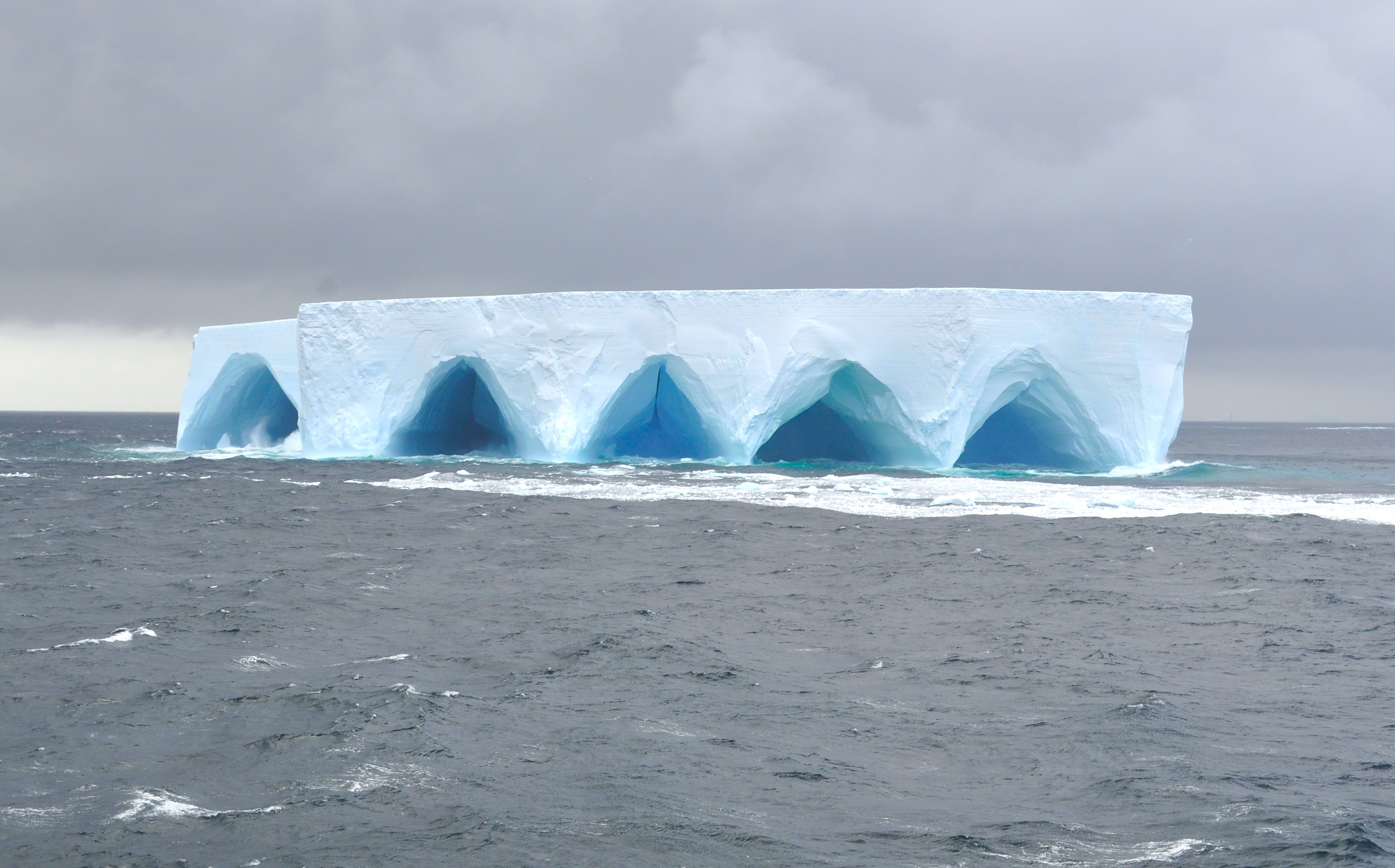
On the second day in the Drake Passage, icebergs began appearing in the morning. Ranging in size — some dozens of meters tall, some just a few — they drifted on the sea surface glowing with a blue light, like ice sculptures left by extraterrestrials, dreamlike and surreal. One large iceberg had been hollowed out by waves into five arch-like tunnels — I called it the "Five-Arch Bridge." Another tall iceberg had a doorway at its base resembling the Zhengyang Gate of the Forbidden City. Our ship passed between two massive icebergs — entering the gates of Antarctica.
Toward evening, the faint outline of mountains began appearing on the horizon.
Landing on the Antarctic Continent
On the third morning I woke up, pulled open the curtains — and there it was, a white mountain filling my entire view. We had arrived in Antarctica. We could go ashore.
On the first day of landing, I finally set foot on the seventh continent. The beauty was unreal — snow-capped mountains and glaciers surrounded us, pure and flawless, everything new and wondrous.
Finally, I met the adorable penguins. Gentoo penguins — the third-largest penguin species in Antarctica, with vivid orange-red beaks that stand out brilliantly in Antarctica's simplified color palette. Meeting penguins up close for the first time, I was charmed by their clumsy cuteness. I learned that day that penguins also build roads. From the mountains to the sea, they trample half-meter-deep grooves in the thick snow — their fixed routes up and down. If you block their path, they simply stand there, bewildered, looking completely lost. One penguin lay motionless on a rock and I thought it was sick, but the guide told me it was just resting. Two penguins met on a narrow path, each turning a shoulder and swiveling their head to pass sideways — like two little adults. One clumsy penguin waddled across the snow with its big belly, slowed down, let its belly go first, lost balance, and toppled face-first into the snow. The fallen penguin pushed up with its belly and stood back up, wobbling onward like a toddler learning to walk — absolutely adorable. When the human path and the penguin path crossed, we always stepped aside for the penguins. They are the owners here; we are the guests.
Afraid of the cold, I had layered up like an onion, and combined with knee-high rubber boots, climbing the mountain through thick snow was no easy feat — I was sweating within minutes.
The afternoon itinerary changed repeatedly due to weather, and we ultimately had to settle for a Zodiac ride to view icebergs. Fortunately we had good luck and spotted a few whales. At the evening recap we learned that two Zodiacs had lost GPS signal and become disoriented — one boat's Indian passengers were clearly still shaken.
The Ice and Snow World
On the second morning I was grateful we were in the second group and didn't have to wake up at six. The Zodiac brought us to shore, and I was delighted to discover what looked like aquatic plants in the water. Antarctica has a desert climate where vegetation struggles to grow — over the entire trip I only saw low-lying plants hugging the ground, yellow-green in color. That day I was once again stunned by the white world before me: under the snow and ice, everything was silver-white, with shadows and the occasional dark ridge of exposed rock sketching the outline of the world. The entire landscape looked like a Chinese ink wash painting. Dots of blue-green parkas accented the white world. If we hadn't come, how silent would this place be? I stopped again and again, as if afraid to disturb the stillness, trying to blend myself into this soundless, pristine world. We climbed along a path marked by small red flags, a silver pool of water on the left, a landscape of undulating ice and snow on the right, and one grimy seal lazily napping on a seaside rock.
Toward evening, just as I was getting ready for bed, the ship's announcement suddenly went off — whales spotted at the 11 o'clock position. I threw on my coat and rushed to the deck. A pod of whales rolled through the sea like a water ballet performance — reportedly bubble feeding.
Penguins, Penguins, Penguins
Today was Penguin Day — the first truly sunny day since arriving in Antarctica. Suddenly, the world's palette gained a dazzling blue: blue sky, blue water, white ice and snow, with black patches of exposed ridge where the snow had melted. Early morning, a Zodiac took us to Hope Bay to see penguins. The inflatable boat wove between chunks of pale blue floating ice, like touring an ice sculpture exhibition. Penguins everywhere — some leaping through the water, others sunbathing on ice floes. These Adélie penguins were impeccably clean, their white chest feathers gleaming in the sunlight, with pale pink feet and black head feathers extending below their eyes, giving them a charmingly vacant expression.
Three penguins stood on a large ice floe. We raised our cameras, knelt on the Zodiac deck, draped ourselves over the side, and waited to capture the moment they dove in. Finally, after our knees were thoroughly sore, snap, snap, snap — the three penguins dove in one after another, and a National Geographic-worthy photo was born. One piece of floating ice was shaped like a blooming lotus, or a swirling skirt mid-dance — impossible to imagine how nature could have conjured such a work of art.
The afternoon landing was changed to a Zodiac cruise due to weather and too many penguins on the mountain. From a distance, the mountainside was covered in dense black dots — all penguins. Nearby groups hopped about, emerging from the water, shaking themselves off, and waddling ashore like little people. One penguin jumped onto our Zodiac — everyone on board was simultaneously startled and delighted, unsure what to do. Under the guide's direction, we cleared a space for it; the little creature seemed panicked too, hopping around looking for an exit. It jumped onto the side of the boat and slipped back, then finally bounced out through an opening at the stern. Quite the highlight of the afternoon.
Toward evening the sky cleared, and we witnessed our first Antarctic sunset. In this white world, any color is a gift.
Weddell Sea
Today we finally reached the Weddell Sea, on the northeast side of the Antarctic Peninsula, embraced by a chain of islands.
Both landings today were uneventful. The morning island had two lazy seals and an abandoned Chilean research station. With only a few minutes left before returning to the ship, I noticed people standing on a distant hilltop and realized we hadn't been up there — I rushed up and descended with the last guide, Joe. There are no trails on Antarctic mountains; each time we landed, guides first scouted the route and marked it with small red flags. Visitors had to stay on the marked path — both for safety (some areas are large ice sheets with no support underneath, potentially causing collapse) and to protect the vegetation. In Antarctica's extreme environment, the only plants are low-growing ones hugging the ground, and we took the utmost care not to disturb them.
The afternoon landing site had conch fossils. Hundreds of millions of years ago, the Antarctic continent was connected to South America and Australia as one landmass — a place once green and teeming with life. Then this runaway child drifted to the southernmost point of the Earth, and it wasn't until the 17th and 18th centuries that humans, after tremendous hardship, rediscovered it.
That evening we were fortunate to encounter around twenty orcas. A mother and her baby swam past our balcony, rolling and spouting twin columns of water. Four penguins huddled pitifully on an ice floe while we raised our cameras, waiting to capture the moment an orca caught one. Thankfully the bloody moment never came — the orcas swam away.
Seal Day
Today was Seal Day. In the morning, we landed to find four or five seals frolicking in the water in a heavy snowfall, making loud barking sounds. Among a group of pale brown elephant seals were two black Antarctic fur seals, all coexisting peacefully on the seaside rocks. A nearby mountain looked remarkably like Mont Saint-Michel in France. Snow fell in thick flakes, blurring the world into a hazy white. Sitting in the Zodiac on the way back, watching the heavy snowfall over this uninhabited world, I felt a profound and indescribable emotion.
At noon, two whales breached near the ship, leaping and rolling continuously. Without time to put on my jacket, I excitedly ran to the deck to watch and photograph. In those ten or so minutes, I finally caught a cold. The last two days of Drake Passage were extremely rough, sleep was poor, followed by long flights home — and once I arrived, my body gave out entirely.
That afternoon was the polar plunge. Having caught a chill watching the whales, I decided to soak in the jacuzzi instead. The jacuzzi and sauna were my greatest pleasures on the ship — body submerged in scalding water, eyes looking out at the white snowy world, mind clear, body warm.
Kayaking
Today was the last day in Antarctica, the third-to-last day of the trip — we would be crossing the Drake Passage again this afternoon. The weather forecast showed two weather systems developing, predicting a Drake Shake.
Today was a miracle. I woke up to a blindingly blue sky. I walked a few laps on deck, taking photos. Vivid blue sky, white glaciers, blue sea, a whale rising and falling, leaving a dotted black line. Then the announcement came — kayaks going out. Such perfect weather, perfect for kayaking. I hadn't signed up the night before, but I ran to base camp to try my luck. My friend had the same idea independently and showed up too. We asked the guide — and were overjoyed to learn there was one extra boat. I sprinted upstairs to change, ran back down, and wrestled my way into the complicated dry suit. And just like that, unexpectedly, on the most beautiful day, we fulfilled a plan we had already given up on — gliding through Antarctica's brilliantly blue waters, threading between ice floes in a kayak. The sky was blue, the sea was blue, the white glaciers glowed with a faint blue tint, and our orange boats traced ripples across the water. As we paddled through the ice-scattered surface, the hull clinked against the ice chunks with a rhythmic knock. That sound will stay in my memory forever. If there's a paradise, this must be what it feels like.
Because the ship was caught between two storms, the captain decided to depart early that afternoon.
Drake Shake
The Drake Passage can be the "Drake Lake" or the "Drake Shake" — entirely a matter of luck. On the return we were unlucky. The ship plowed through the Drake Passage under a limitless leaden sky where sea and sky blurred together, wind howling, snow and ice sweeping sideways, pool water churning and leaping out to slap the deck. I did one lap on deck — compared to the morning, it was heaven and hell. Our ship, built in 2022 with the highest ice-breaking capability among non-icebreakers, made me wonder how explorers from the 16th to 19th centuries could have crossed these treacherous waters time and again with far inferior equipment, seeking out that unknown continent. What courage, what burning curiosity, must have driven those life-risking voyages of discovery.
The previous night I barely slept. All night the ship pitched like an earthquake, as though little gremlins had thrown a party in the cabin. At one point a glass tipped and rolled back and forth, clinking — I got up but couldn't find it. Then a cabinet door swung open and shut with a bang. Then the life jacket on the table fell to the floor. We got up five times to tidy things. In the morning, everyone looked exhausted. Sitting in the seventh-floor observation lounge, waves crashed one after another against the glass windows, the ship seemingly plunging into the sea one moment and riding a crest the next — like a rollercoaster. At dinner, a sudden cacophony of crashing — a stack of plates hit the floor. While having tea, a large wave sent two cups sliding toward the edge of the table. I grabbed them just in time, and the guide next to me called out, "Good catch!"
Green Again
Two days through the Drake Passage — bones shaken loose, head dizzy. Finally, our ship entered the Beagle Channel. Green again. Blue sky again. A vibrant, living world again. The Drake Passage is Antarctica's toll gate — you have to pass through it to truly appreciate Antarctica's beauty. And so, we said goodbye. Antarctica — so beautiful, so pristine. The world of penguins, seals, and whales. To have encountered you in this lifetime is one of life's greatest gifts.
Because we left Antarctica half a day early, we had an evening in Ushuaia to go ashore and explore the town. Due to strong winds the ship couldn't dock at first, so we admired the town's night lights from a distance — boats moored in the harbor, their lights reflected on the water, swaying with the waves. Just as we were about to give up on going ashore, the ship moved and docked. We hurried off. At the pier we ran into Will, our kayak guide — this Scottish fellow of small stature has four generations of family working in Antarctica. That day in Antarctica he had told us his father was on another ship just thirty nautical miles away. That night his father was also in Ushuaia, and they'd arranged to meet at a bar. The streets of Ushuaia were wet after the rain; it was around nine at night and most shops were closing. My friend and I slipped into a gift shop two minutes before it closed and bought postcards — but the post office was shut. We left somewhat deflated, clutching our postcards. Who would have thought that the next morning we learned the post office had opened, and we rushed back into town to finally fulfill that little wish.
Then came a day and night of traveling. Car from the port to the airport, Ushuaia to Buenos Aires, Buenos Aires to the United States. A day and night in the air, and finally home. I hadn't expected to return from a dreamlike world of ice and snow to a real world of ice and snow. A cold snap had swept through Denver — temperatures actually lower than in Antarctica. I complained on WeChat, and my friend replied: "Perfect weather to stay home, binge shows, and watch Blossoms Shanghai." Those words touched something in me — yes, life can also be that comfortable. The last two days I had been sick, catching red-eye flights home feeling miserable. Once home, my throat ached and I ran a fever. Body worn down and travel fatigue setting in, I did something unprecedented — I slept a full fourteen hours.
Epilogue
After returning from Antarctica, I'm still somewhere between worlds. Images from the journey keep surfacing — blue ice floes, adorable penguins, the faces of fellow passengers, fragments of the trip.
The Antarctic journey redefined certain words in my vocabulary. Simplicity and purity take on a new meaning in Antarctica. There, sound quiets down — the world falls silent, broken only occasionally by the calls of penguins and seals. Color fades away, leaving only black, white, and grey — and on clear days, blue. Lines simplify to just the arc of sea, land, and sky. Standing on Antarctica's icy continent, the world grows still, clear and simple; time and space come to a halt, the surroundings so quiet that even your breathing slows, and everything becomes eternal. The purity and simplicity here are absolute.
In truth, we only skirted Antarctica's coastline and made a handful of landings. Those truly brave explorers ventured deep into the Antarctic interior, all the way to the Pole. Humanity's urge to explore the unknown never stops.